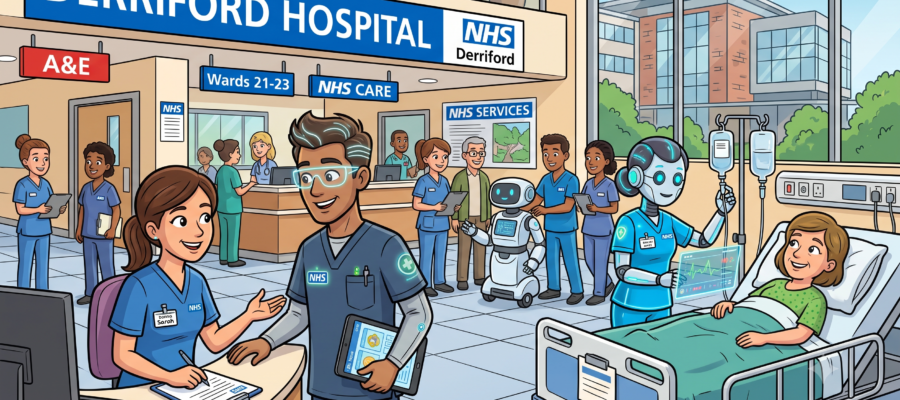
The Digital Frontier: Balancing AI Integration with NHS Reality
The intersection of modern healthcare and artificial intelligence has moved firmly from the realm of science fiction into real-world policy and discussion. This shift is vividly mirrored in contemporary media, with television medical dramas like The Pitt increasingly highlighting the complex relationship between frontline medical staff and algorithmic diagnostic tools. As the National Health Service (NHS) navigates historic logistical and financial strains, the potential integration of advanced AI models—such as Google’s Gemini—presents both profound opportunities and deep systemic challenges.
On paper, the advantages of weaving a sophisticated AI infrastructure into the UK healthcare matrix are substantial:
- Administrative Relief: Clinicians currently spend a disproportionate amount of time on clinical documentation and data entry. Advanced language models can automate notes, streamline triaging, and manage scheduling, freeing up hours for direct patient care.
- Diagnostic Support: AI can analyze vast amounts of medical literature, imaging, and patient data in seconds, offering real-time decision support to doctors, identifying patterns in rare conditions, and predicting patient deterioration early.
- Operational Efficiency: Machine learning can optimize bed management, predict seasonal admission spikes, and streamline the supply chain across trusts.
However, the path to a fully integrated digital NHS is fraught with practical roadblocks that cannot be ignored. The most immediate hurdle is the state of the existing infrastructure. Many NHS trusts are still burdened by fragmented, legacy IT systems that struggle to communicate with one another, let alone support complex, real-time AI processing.
Furthermore, introducing AI into clinical settings raises critical ethical and operational questions:
- Data Privacy and Security: The NHS holds one of the most comprehensive, centralized medical datasets in the world. Ensuring absolute data security and maintaining public trust while collaborating with commercial technology partners remains a delicate tightrope.
- The “Black Box” Problem: For AI to be safely utilized in diagnosis, its reasoning must be transparent. Clinicians must understand how an algorithm reached a conclusion to safely validate its recommendations.
- The Human Element: AI is a tool to augment, not replace, human clinical judgment. Striking the right balance ensures that technology enhances the patient-doctor relationship rather than distancing it.
For a technology like Gemini to successfully weave into the NHS, implementation cannot happen overnight or via a top-down mandate. It requires sustained investment in core digital infrastructure, rigorous clinical testing, and a collaborative approach that respects the unique, public-service ethos of British healthcare. The future of the NHS relies on modernization, but the transition must be as secure and seamless as it is innovative.
Leave a Reply